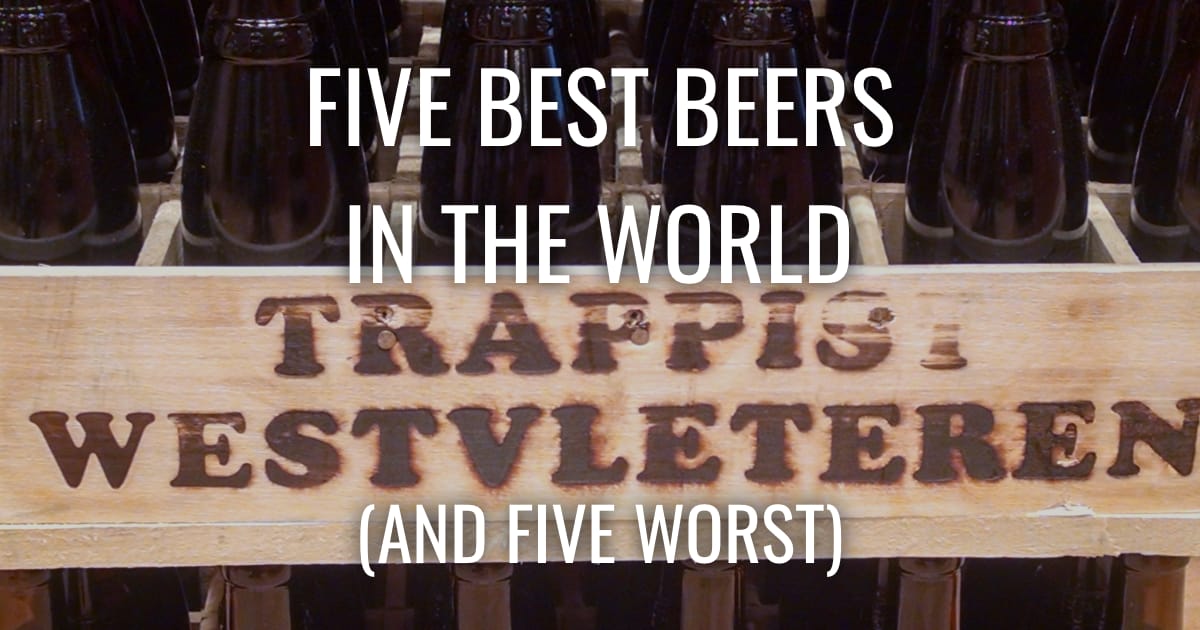
5 Best Beers in the World
We visited 36 countries on our trip around the world, and every single one of them had at least one beer that was brewed there. Here are the 5 Best (and 5 Worst) Beers in the World.
Read More
On our travels around the world, we’ve had some great beer. We enjoyed a variety of beers at Weihenstephan (the oldest still-operating brewery in the world) in Freising, Germany.
We’ve sampled a pilsner straight from the tap at Pilsner-Urquell (the brewery that invented Pilsner) in Plzeň, Czech Republic.
We’ve tried Jacobsen Dark Lager (only available in Denmark) at the Carlsberg Brewery in Copenhagen, Denmark.
And we’ve toured the somewhat disappointing Musée Européen de la Bière in Stenay, France.
As delightful as each of these stops was, when it comes to beer, there's no place else quite like Belgium. Unlike Germany, where beer is defined by Reinheitsgebot — the German Beer Purity Law that dictates beer can only contain four ingredients: water, hops, barley (malt), and yeast — there are no limits to what ingredients can be added to a Belgian beer. Consequently, the sheer number of beer styles brewed in Belgium is staggering.
So when I learned that Sandeman’s, our go-to choice for free walking tours in cities throughout Europe, offered a Belgian Beer Tasting Experience in Brussels, I didn’t want to pass it up.
We visited 36 countries on our trip around the world, and every single one of them had at least one beer that was brewed there. Here are the 5 Best (and 5 Worst) Beers in the World.
Read MoreThe tour started at Scott’s Bar, which is sort of the unofficial Sandeman’s New Brussels hang-out spot, where Senna, our guide to the world of Belgian beer, took us upstairs and offered us a choice of two beers, a Westmalle Trappist Tripel or Chimay Red. I’d had the Chimay before, so I opted for the Westmalle. I think I would have preferred the Chimay, but the Westmalle was nice enough.
Then, after a brief example on how to pour a beer properly, Senna treated us to a short history of beer in Belgium.
He talked about how, back in the old days (before the germ theory of disease), the water in Belgium wasn’t the safest beverage to drink so people turned to beer instead. The alcohol percentage in these beers was low, maybe 1% to 2%, and everyone drank it, even the kids.
But how did brewing beer fall under the purview of Trappist monks? In the year 529, Saint Benedict laid down the rules for living a monastic life (known as the Rule of St. Benedict, and one of these (Rule 48) is that a monastery must “live by the work of their hands.” For certain monks in Belgium, this meant brewing beer.
Monks in Belgium started selling their wares to the public in the 11th or 12th century, and today there are only 10 beer-brewing Trappist monasteries in the world, 5 of which are in Belgium.
But, like any quality product that becomes popular, Trappist beers started to spawn inferior imitators out to make a fast buck using the exclusivity of the Trappist name. In order to maintain the purity of the product (and trademark), the International Trappist Association was founded in the 1980s and introduced three tenets that need to be followed before the beer can be labelled as “Authentic Trappist Product” (ATP):
This third tenet means that after the living expenses are taken care of, any remaining income from the sale of the beer goes to a nonprofit organization of the monastery’s choosing. So when you drink Trappist beers, you are indirectly doing charity work.
And with that good news, we moved on from Scott’s Bar. It had started raining while we’d been inside, so we trudged through the damp, chilly streets of Brussels to our next stop, Moeder Lambic, a popular local hangout. It was a Friday night, and this place was already very busy. Because there were so many of us (20 or so) we had to sit outside. Fortunately, we had blankets and umbrellas to keep us warm and dry while we tried three more Belgian beers:
Senna had us wait before we tried the last beer. He wanted to give us a little background on the gueuze style of beer. The first thing he told us is that you can’t make a gueuze without first making a lambic.
Unlike lagers and ales, which are brewed in sterile conditions using yeast from the Saccharomyces family, lambic beers are brewed open to the environment and are subject to the wild yeast Brettanomyces, which is often considered a contaminant in other beers. This style of brewing gives lambics a sour taste and no two are ever quite alike.
Once you have your lambics, you make a gueuze by mixing two lambics together — and old one (typically two to three years or older) and a young one (around one year).
The resulting concoction is then bottled and undergoes a second fermentation. This results in a unique (and really sour!) brew with a lot of carbonation — which is why a gueuze is sometimes called “Brussels Champagne.” The gueuze we tried wasn’t to everyone’s liking, but I enjoyed it quite a bit.
The day before the beer tour, I'd bought a bottle of Westvleteren 12, considered by many to be the best beer in the world.

I asked Senna about it. He chuckled and asked how much I’d paid for it. I paid €18 — which was a lot — but it’s not the easiest beer to come by (we did see it in Brugges later on for as low as €11).
It’s only sold at the Brouwerij Westvleteren for a limited time each month after the monks brew a batch. Buyers have to make a reservation to visit the monastery and are limited to buying a case or two at a time. You can only visit once every 60 days and you aren’t allowed to re-sell it to a third party (which all the shops were, in fact, doing).
If you manage to get an appointment, an entire case will only run you €40 (plus a €12 deposit for the crate and bottles).
So Senna was a little down on the shops in Brussels who were trading on the hard work of the monks by selling this beer for exorbitant prices because of its reputation. And I get that. But on the other side, very few beer-loving tourists are going to make two-hour drive to the monastery in Westvleteren to pick up a case.
My only regret about the tour was that it didn’t take us to the legendary Delirium Café with its thousands of available beers (2000 or 3000, depending on the source) as advertised. But it’s a pretty popular tourist destination and, as it was a Friday night, Moeder Lambic was probably a more sound choice. It also gave us the chance to take in a little of the local scene, as opposed to what would certainly be the tourist bustle of Delirium. I’d still had some good beer and a great time, so I considering all that, I can overlook this one small transgression.
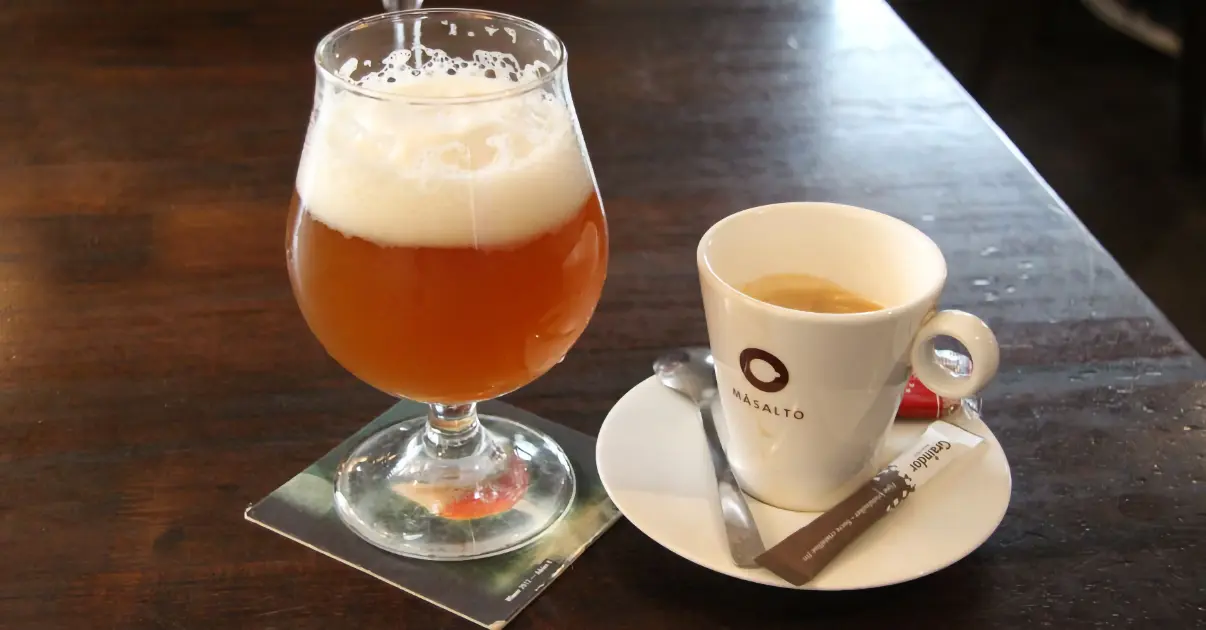
Header image: Beer and coffee in Belgium.
Taking on the World is an Amazon Associate and earns from qualifying purchases.

Header Image: Description. Image from the author's collection.